
The Great Japanese Stock Revival: Why Global Investors Are Rushing to Tokyo — and How You Can Join the Party
By Toi Anna - Business Columnist
Warren Buffett saw it first. Then the hedge funds followed. Now the question Wall Street is quietly asking is not whether to buy Japan - but how much, and how fast.
The Nikkei 225 delivered roughly a 26 percent gain in 2025, its third straight year of double-digit returns, obliterating records that had gathered dust since the peak of Japan's 1989 bubble. But this is not your grandfather's Japan rally - no weak-yen sugar high, no one-trick-pony story. What is unfolding in Tokyo is a structural regime shift three decades in the making, and most retail investors are still standing on the sidelines.
The benchmark Nikkei 225 index closed 2025 up about 26 percent, marking its third consecutive year of double-digit returns, and finished the year above 50,000 for the first time in its history. While casual observers are quick to attribute the rally to a weak yen, seasoned money managers point to a more profound, structural "regime shift" - driven by the death of deflation, an aggressive pro-growth political strategy dubbed "Sanaenomics," and a corporate-governance revolution that is finally pushing Japanese executives to put shareholders first.
For foreign individual investors watching from New York, London, or Sydney, the opportunity is tantalizing. But navigating Japan's financial markets is famously complex. From the "100-share" minimum buy-in rule to currency fluctuations and tax treaties, the barrier to entry can look like a medieval moat. This guide explains why Japan is hot right now and, more importantly, how you can practically get a piece of the action.
Japan's 30-Year Curse - Broken
To understand why Japan is soaring, you first have to understand what smothered it for three decades: deflation. When prices fall, consumers delay purchases, companies freeze hiring, and cash is hoarded rather than invested. In 2025 that psychological spell broke. Japan's national core CPI (excluding fresh food) was running clearly above the Bank of Japan's 2 percent target through the year, and by November 2025 headline inflation had reached 2.9 percent - evidence that price growth has taken root.
In response, the Bank of Japan is performing a delicate, historic normalization. Under Governor Kazuo Ueda, the central bank raised its policy rate to 0.75 percent in December 2025 - the highest since 1995 - and then hiked again to 1.0 percent in June 2026, its highest level in three decades, as an oil-price shock tied to the Iran war pushed up imported inflation. Analysts expect further gradual increases if inflation stays persistent. Crucially, the tightening is being underpinned by domestic wage growth: heading into the 2026 "Shunto" spring wage negotiations, the Rengo labor confederation again pushed for base-pay hikes of around 5 percent, reinforcing the "virtuous cycle" of rising wages feeding consumer spending and corporate investment.
At the political helm is Prime Minister Sanae Takaichi, Japan's first female prime minister. In a snap election held on February 8, 2026, her Liberal Democratic Party won a historic landslide - 316 of the 465 lower-house seats - handing the LDP-led coalition a two-thirds supermajority, the first time a single party has reached that threshold in Japan's postwar history. That mandate powers her pro-growth agenda. "Sanaenomics" blends fiscal stimulus with targeted "crisis-management" investment in artificial intelligence, next-generation semiconductors, nuclear energy, and other strategic sectors, funded in part through a large economic package enacted after she took office.
The Boardroom Revolution No One Saw Coming
While macroeconomics sets the backdrop, the real change is happening at the corporate level. For decades, Japanese companies hoarded cash, held defensive cross-shareholdings, and largely ignored foreign shareholders. That began to shift when the Tokyo Stock Exchange launched its March 2023 campaign asking listed companies to run their businesses with an eye on "cost of capital and stock price". The exchange has since pressed companies to disclose concrete progress, and further code work has targeted the "idle cash" problem - nudging firms to deploy dormant capital rather than sit on it.
The response has been striking. Governance has moved from a compliance exercise toward genuine value creation: a large majority of TSE Prime Market companies now appoint at least one-third independent directors and maintain independent nomination and remuneration committees. Share buybacks surged to record levels in 2025 - well above pre-pandemic norms - and merger-and-acquisition activity accelerated sharply as companies unwound cross-shareholdings and shed non-core assets. Average return on equity has climbed off its historic lows toward and past 9 percent.
Where the Smart Money Is Flowing
Global institutional investors have taken notice. Foreign net buying of Japanese equities in 2025 reached its strongest level in more than a decade - on the order of several trillion yen (tens of billions of dollars) - the biggest wave of foreign buying since the early Abenomics rally of 2013. Even Warren Buffett has added to his stakes in Japan's major trading houses - a widely watched vote of confidence.
And the momentum has only accelerated in 2026. The Nikkei 225 cleared 60,000 in the spring and then broke through 70,000 for the first time in mid-June, reaching an all-time high near 72,800 on June 22, 2026, before easing back to around 70,000 by month-end - a gain of more than 70 percent over the prior twelve months, powered by an AI-investment boom, a historically weak yen, and the continuing governance re-rating. That leaves the market at nearly double its 1989 bubble peak of about 38,900. Such a vertical run has reopened the perennial debate over whether latecomers are buying an entry point or a top, and after a move like this a sharp pullback is always possible. But the longer-term thesis rests on structural drivers - the end of deflation, real wage growth, and more shareholder-friendly capital allocation - that are still firmly in place. So the more practical question for most global investors isn't where the index lands next quarter, but how to actually get exposure - which is where the real obstacles begin.
Why Buying Toyota Is Harder Than It Sounds
If you're a retail investor, you might think: "Sign me up - how do I buy Toyota or Uniqlo directly?" Here you hit the Great Wall of Tokyo: the 100-share standard trading unit. Unlike markets where you can buy a single share, the Tokyo Stock Exchange trades domestic stocks in 100-share lots.
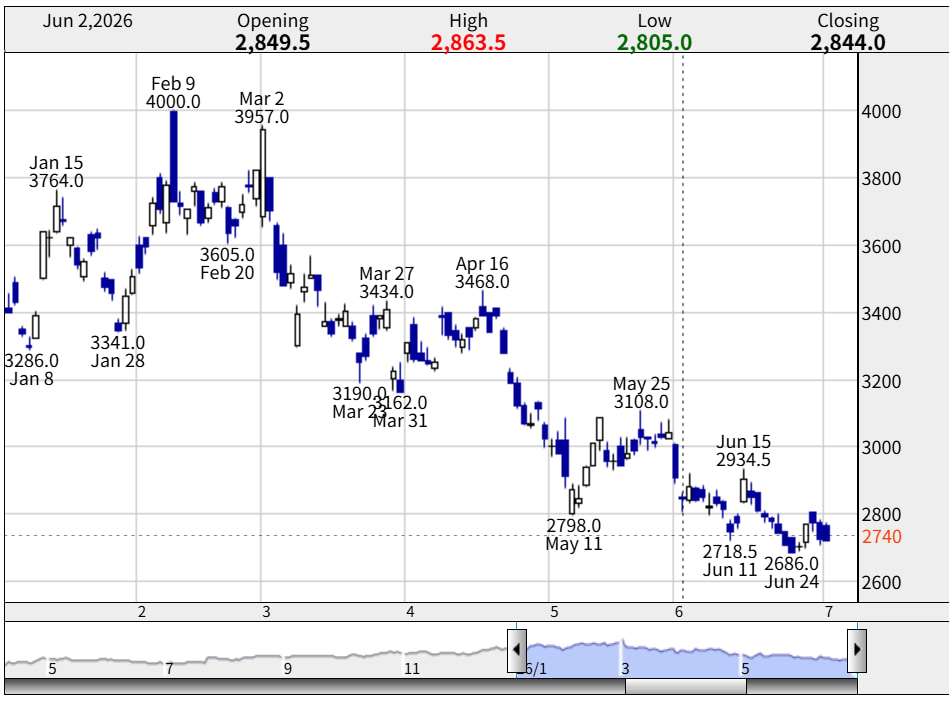
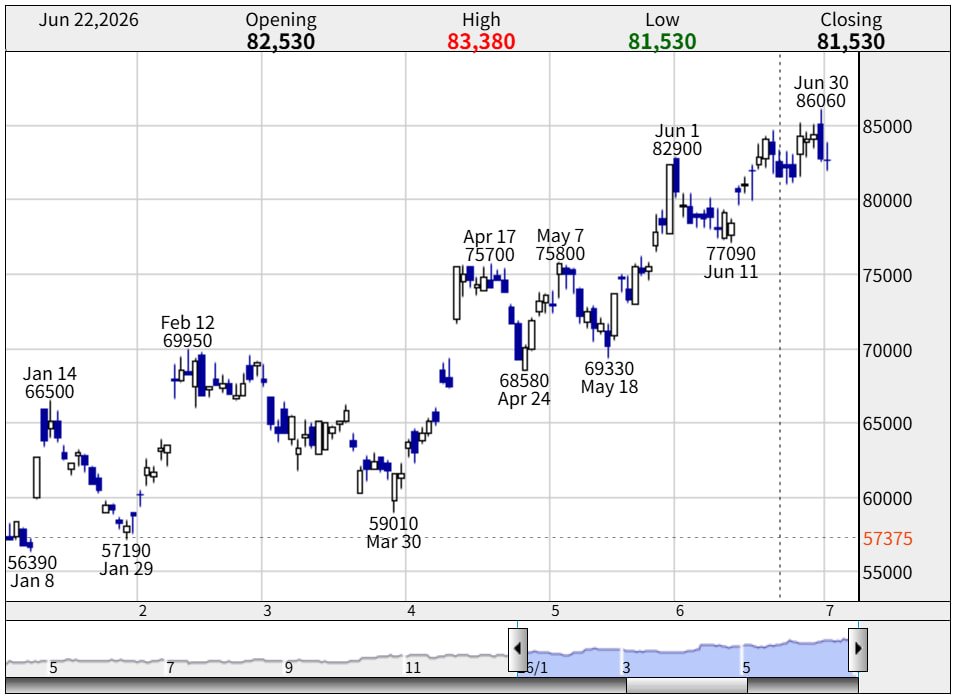
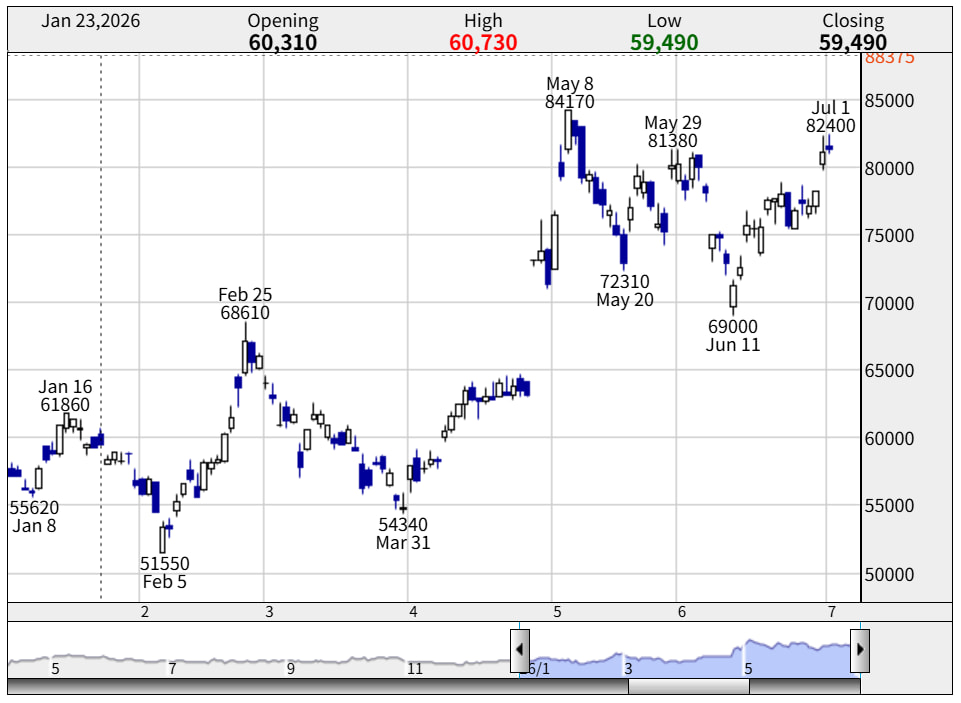
That makes upfront capital eye-watering for the priciest names. At recent prices, Fast Retailing (parent of Uniqlo, ticker 9983) traded around ¥75,510 a share, so one 100-share lot costs roughly ¥7.55 million (about $50,000). Keyence (6861) near ¥77,120 implies about ¥7.71 million (~$51,000) per lot. Even Toyota (7203), around ¥3,022 a share, still requires roughly ¥300,000 (~$2,000) for a single lot.
TOYOTA
Fast Retailing
KEYENCE CORPORATION
This is a real barrier to diversification. The TSE has urged listed companies to run stock splits and bring minimum investment units below ¥100,000 (about $700), but compliance is voluntary and only a fraction of companies have done so. And global brokerages such as Interactive Brokers generally do not offer fractional-share trading for Japanese domestic equities, due to the settlement structure of Japan's book-entry system (JASDEC). On that path, you're either in for a full 100-share lot or you look elsewhere.
The Shortcuts Smart Money Actually Uses
Fortunately, you don't need fifty grand in cash to invest in Japan. Two effective detours are American Depositary Receipts (ADRs) and Exchange-Traded Funds (ETFs).
The ADR route
Many of Japan's mega-caps trade directly on U.S. exchanges as ADRs - including Sony (SONY), Toyota (TM), Honda (HMC), Mitsubishi UFJ Financial Group (MUFG), and Canon (CAJPY). Trading an ADR works just like trading a U.S. stock: single shares, priced in U.S. dollars.
The catch is selection bias. Only a small, handpicked group of Japanese companies offer liquid ADRs, so the mid- and small-cap names - where governance reform is arguably unlocking the most value - are largely unavailable this way. Research coverage is thinner too: the average MSCI Japan constituent is followed by far fewer analysts than the typical S&P 500 name.
The ETF route
Buying a single ETF share gives you diversified exposure to hundreds of Japanese companies and bypasses the 100-share rule entirely. The key decision is currency hedging, because you're buying yen-denominated assets in a dollar account, which exposes you to the USD/JPY rate:
- WisdomTree Japan Hedged Equity Fund (DXJ) is currency-hedged, using forward contracts to neutralize yen moves. When the yen is weak - which tends to flatter Japan's big exporters - a hedged fund can meaningfully outperform an unhedged one.
- iShares MSCI Japan ETF (EWJ) is the largest unhedged option, leaving you fully exposed to the yen.
- iShares JPX-Nikkei 400 ETF (JPXN) is also unhedged and screens for higher-quality companies with strong ROE and governance.
Rule of thumb: if you expect the yen to keep weakening, a hedged fund like DXJ captures more of the equity upside; if you think the yen has bottomed and BOJ hikes will drive a yen rally, an unhedged fund like EWJ or JPXN lets you capture both equity and currency gains.
A Note on Taxes
Cross-border taxation of Japanese dividends and capital gains - the withholding rates, any treaty relief, and the paperwork involved - is genuinely complicated, and it varies with your country of residence, your broker, and how you hold the shares (directly, or via ADRs or ETFs). The rules also change over time. Rather than risk steering you wrong, this guide won't attempt a detailed walkthrough here: before you invest, confirm the specifics with a qualified tax professional and with your broker, and factor the after-tax result into your decision.
So, Should You Buy Japan?
Japan's stock market is undergoing a once-in-a-generation renaissance. Under Prime Minister Takaichi's Sanaenomics stimulus and the Tokyo Stock Exchange's governance push, Japan Inc. has become leaner, more cash-distributing, and more shareholder-friendly.
The practical on-ramps for global investors have never been clearer. You can own Japanese blue chips through ADRs, play the yen with hedged or unhedged ETFs, or - if you're willing to handle the 100-share units - buy directly through a global broker. Whichever route you take, get the tax treatment checked by a professional first: the after-tax outcome can differ meaningfully depending on how you hold the shares and where you're resident.
---
This article is for general information only and is not investment, legal, or tax advice. Tax treatment depends on your specific residency and circumstances; confirm details with a qualified tax professional and with your broker before investing.
Related Articles
-
NY Dow hits record high while Nasdaq extends decline on the 2nd
Fri Jul 3, 2026 8:14 am JST Market -
U.S. forex market summary: Dollar softens to 160.60 yen after weak jobs report
Fri Jul 3, 2026 7:55 am JST Currency -
IPS rises for fifth straight session on plans to advance submarine cable landing station development in Wakayama
Fri Jul 3, 2026 9:14 am JST Catalyst -
Kubota Pharmaceutical Holdings draws buying interest on milestone payment receipt
Fri Jul 3, 2026 9:09 am JST Catalyst -
Tokyo Market Outlook: Kioxia Holdings breaks below 25-day moving average - what it signals for tomorrow's Tokyo market
Thu Jul 2, 2026 5:52 pm JST Market -
KITAKEI, First Half Ordinary Profit Decreases by 10%, Mar-May Ordinary Profit Decreases by 8%
Fri Jul 3, 2026 4:00 pm JST Earnings -
Chugoku Marine Paints, Revenue Forecast for the Fiscal Year Revised to 160 Billion Yen
Fri Jul 3, 2026 3:30 pm JST Revision -
K.R.S.Corp, First Half Ordinary Profit Decreases by 6%
Fri Jul 3, 2026 3:30 pm JST Earnings -
ASKUL, Returning to Profitability This Year, Dividend Raised by 10 Yen
Fri Jul 3, 2026 3:30 pm JST Earnings -
ARCS, Mar-May (1Q) Ordinary Profit Increases by 6%
Fri Jul 3, 2026 3:30 pm JST Earnings